Using AI Is the Right Call, and It Isn’t the Answer
A lot of people I talk to now have access to AI tools at work, whether they run a company, lead a team or do the work themselves. Many still struggle with what AI means longer term to their work and that of their teams.
That isn’t a failing on anybody’s part. AI tools arrived in most workplaces faster than anybody’s thinking about what to do with them, so people are working it out as they go: learning the tools, learning what good looks like now, and trying to understand what’s being asked of them.
Using AI is the right call. Where a piece of work has a binary output and passes the same quality checks, let AI do it. Separately, if AI lets you expand your reach several times over without adding more people, do that too.
In Reimagine to Deploy I set out how I see work flowing: Reimagine, Research, Innovate and Iterate, Develop, Deploy. For most of my career, it was the unreliable estimates around getting the work built and shipped that caused most of the angst. Getting the work done was the bottleneck.
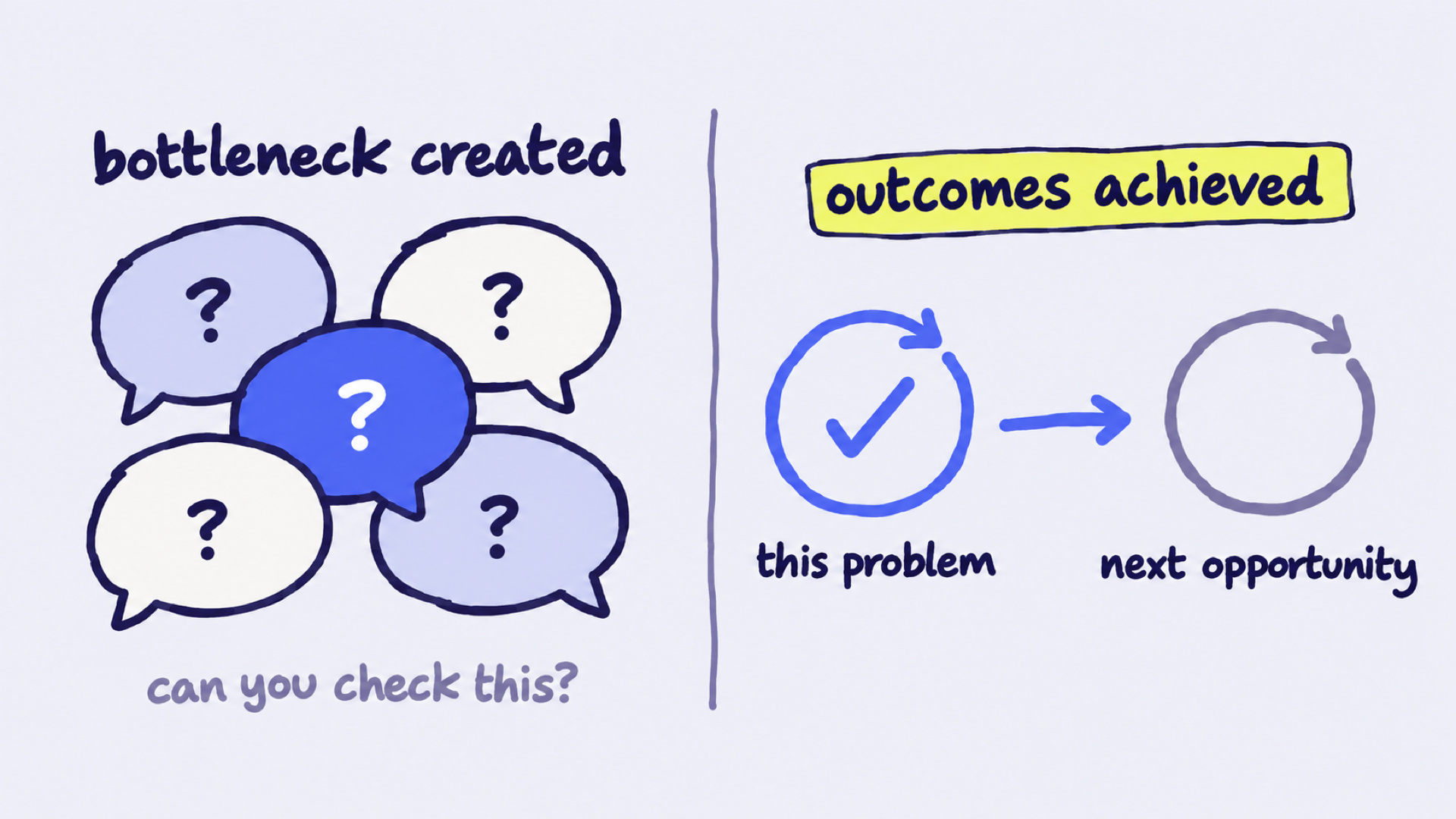
AI made getting the work done fast and cheap, so the bottleneck moved. Now there’s more output than anybody has time to check properly. The fix is upstream: more time can be spent on agreeing what outcomes are being looked for, reimagining what the work should be, researching it, while innovating and iterating to a higher quality bar. Just because you can build doesn’t always mean you should.
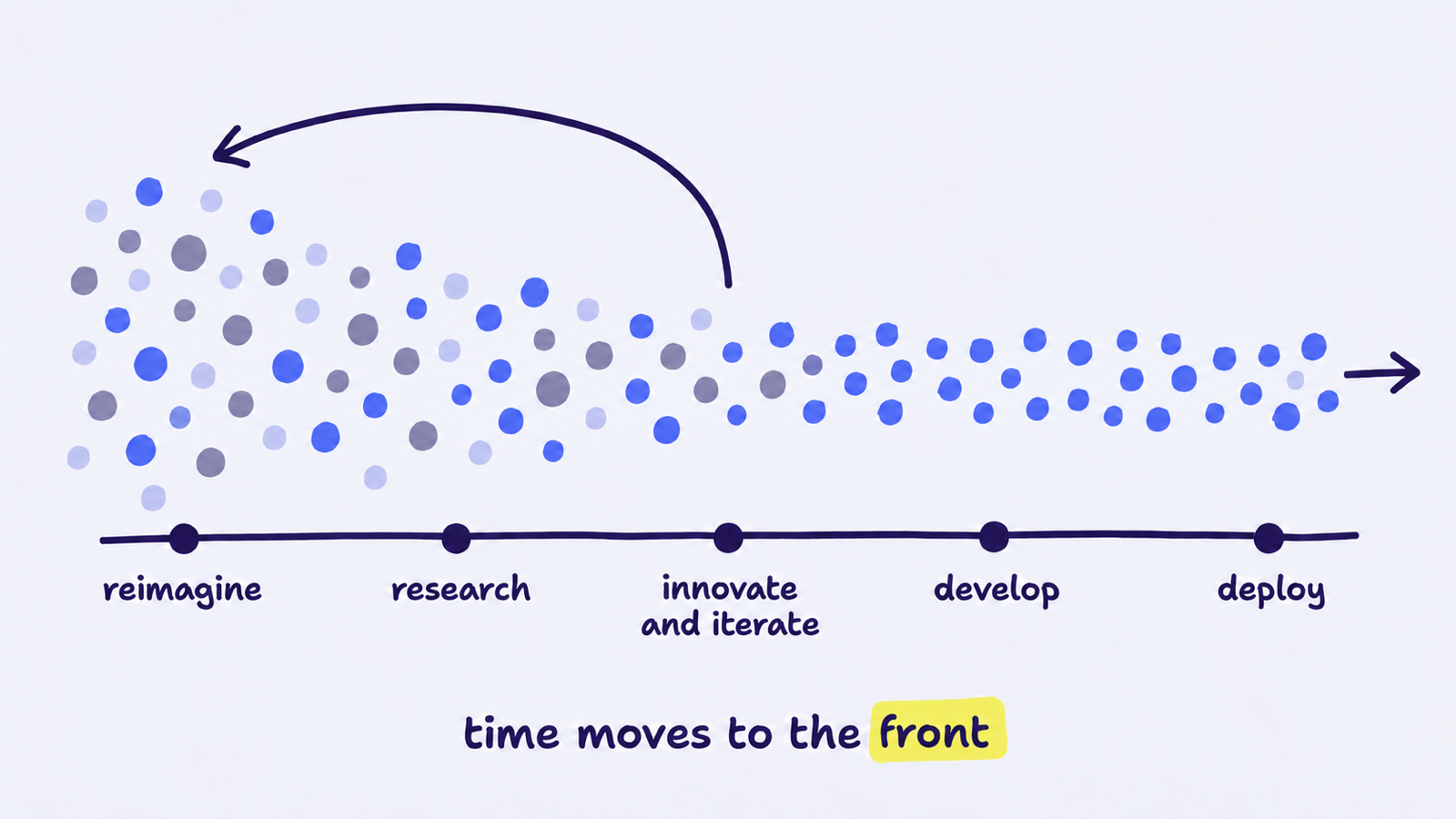
This is a new work mix for most people. It’s not less work but different work, and it should raise the quality bar. The pressure was always to deliver, but now that delivery has been commoditised, the focus is on quality. The work is also a loop rather than a straight line: with more time to reimagine what’s possible before moving down any research path, further iteration loops build quality and confidence earlier than any past development cycle. Most people never felt they’d the time to learn that properly, so the pace of this higher-level work, thinking more critically, is a change people are getting used to.
Benedict Evans makes the point on his podcast that a lot of what a company runs can’t simply be swapped out: nobody is replacing an accounts system wired into SAP, Stripe and Workday with an AI tool somebody built on the side. His view is that most companies will pay somebody to work out what to do. My experience is that working it out and implementing it are two different jobs. A plan for what to do doesn’t change how a team actually works. That second job sits with the people doing the work, and with whoever works alongside them.
Using AI may or may not need fewer people, depending on what you’re trying to achieve. What it nearly always needs is people working differently, and somebody tasked with making that change: coaching people through the thinking at the front of the work, helping them build momentum, and helping them execute at a higher level once they’re through it. That’s what I mean by Enabling. You don’t hand somebody an AI tool and expect different work back. The tool is just that: a tool.
In Describe the Work, Not the Title I called this Enabling mode: the outcomes you’re accountable for are your team’s, not your own. In Improve the People, Not Just the Work it was the mode most often missing. This piece is the practical side of Enabling mode: getting close to somebody’s work, helping shape what needs to be done and building momentum that compounds across a business.
Whether People Make the Leap
When the work changes this much, the real question for everybody is whether they can make the jump, and whether they want to. It’s a fair question to ask of yourself, and it’s the same one anybody leading a team is asking about the people in it. The skills the work needs are shifting, and anybody whose skills don’t shift with them is exposed, whatever their title.
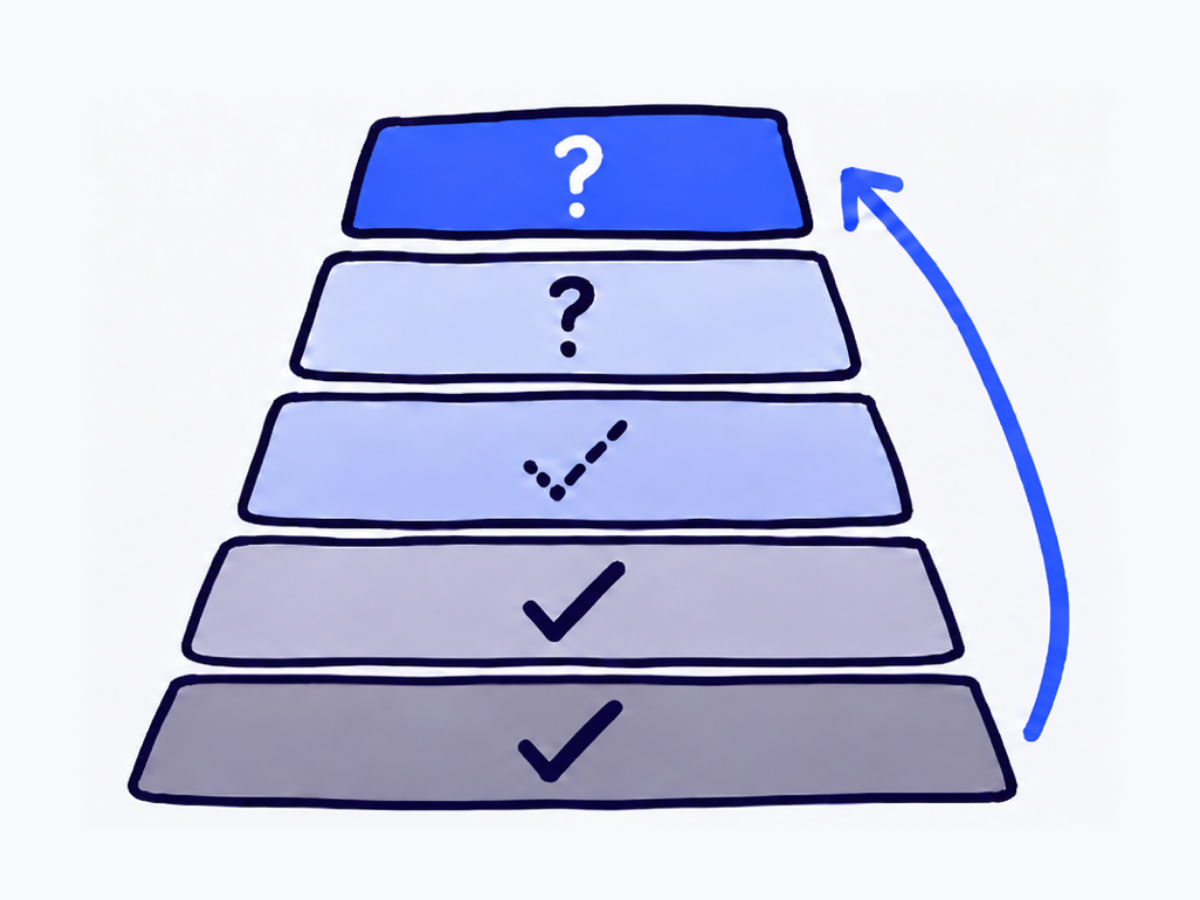
Four questions help, and they build on each other:
- Can you change?
- Are you willing to change?
- Are you excited by this change?
- Does this new way of working appeal to you?
The first two are about ability and willingness. The last two are about wanting to, and that often comes later. Somebody who can change and is willing to, but isn’t excited, is often carrying a real fear of what the change means for them. That’s natural, and helping with it is part of Enabling: coaching them through it, building their confidence, and showing them they can. While this is an investment, it can often be more beneficial to train existing people rather than replacing and losing institutional knowledge.
AI makes the questions above easy to skip, because it’s so easy to start. You just type a question in plain English and the AI sends something back. So people start, and a lot of what gets produced early on is output without much thinking behind it. That isn’t laziness. Most people haven’t been shown where to start, so they begin where they already are: doing the job the way they always did it, just inside the tool. The moment that matters is when somebody stops and asks what the job should look like now. Even before that, somebody asking “what do you want me to do with this?” because they’re keen to get going is a good sign. Better still are those with high agency, who dive in and start rethinking the work for themselves.
Teams get reshaped as much as the work does. Companies aren’t families. They’re professional teams, and professional teams keep getting refined, because keeping somebody in a role that’s not delivering isn’t fair on them or on the rest of the team.
Answering those four questions above properly takes time and an understanding of individuals, and at scale that often doesn’t happen. Large organisations tend to decide in broad strokes, because at that size decisions come down to numbers. The Wall Street Journal reported Uber cutting its “micro-teams”, the ones with one or two direct reports, by nearly half, as part of cutting 10% of its staff and ending up with 20% fewer managers. Those teams are being cut by the numbers, not person by person. That might not seem like the right or best approach, but it’s real.
Leaders deciding fast under real time pressure is part of it, but it’s more a failure of the talent systems within these companies than of the leaders themselves. Those systems weren’t built for this pace of change, and they don’t know what to do with the manager of a team of one or two any more. When the number of people reporting to each manager is the only evidence they can offer, that number is what gets acted on.
Alongside the Work, Not Taking It Over
What does working alongside people actually look like?
Here’s one example from when I was working in a business with good technology, sitting in a market COVID had decimated, that needed to work out where it could go next. The company needed a new direction, new markets, new customers and team focus. My job was to help realign and relaunch it into a new market, while managing the cost base through this transformation. The result was a successful new venture raise plus new enterprise customers, with contracts of up to seven figures. To get there took a lot of time in Doing mode, doing the work myself, and Enabling mode, which is mostly Coaching people and Editing their work, across finance, operations, HR (which I renamed talent), product, and sales and marketing.
As I began working with the team, one person in the company was doing office admin and operational finance tasks, and they were really good with people. As we looked at where we needed people, it was easy to see this person could be great in a talent role. Understanding a person’s aptitude, rather than their functional role, is one place where Enabling starts.
Four things happened with this person, running together rather than in order:
- Working out together what the talent function was going to be about.
- Company recruiting, and building the job levels, roles and specs that didn’t exist yet.
- Completing the needed administrative tasks, but ensuring these were supporting and not seen as the primary focus of the talent function.
- Setting objectives and goals, for individuals, for functional areas and for the company.
The core objective was to bring the team together, energise them, and ensure clarity on what was expected from everyone to help the company reach its goals.
On other fronts, I spent time closing deals plus building financial forecasting and modelling tools: sensitivity analysis, spreadsheets with a dozen tabs, to help the founders make decisions and understand opportunities while telling a financial story outside the business. Sales contracts and finance in this instance were my own Doing work, and while I was in Enabling mode, the Coaching and Editing had a greater focus on the talent function’s needs. Working on the actual work alongside the team is how everybody builds trust, and how they come to understand not just how to do the work but what outcomes it needs to produce.
What Coaching asks of you changes with the person. Mike Krzyzewski coached Duke basketball and, at the same time, the US national side, so college players and the best NBA players in the world. He described the difference like this: “In college, you’re coaching youngsters who pretty much have to adapt to you because they haven’t crossed the bridge of experience in a lot of these areas, and you have. When you’re coaching the NBA players, they’re professionals, and they’ve crossed a lot of bridges.” With the professionals, he says, the aim is to be “incredibly adaptive to one another”, and he gives them far more say.
The level of the conversation is different, but the Enabling underneath it is the same job. With the talent function in the company above, this person was nearer the college end in that the work and role were new to them, they’d bridges still to cross. That meant building it with them, running it with them, making them comfortable with it, until they didn’t need me as much. By the end, they were fully self-sufficient. That’s the outcome you want, as long as the quality bar and the momentum hold. My time could then go elsewhere, as there’s no reason to prioritise time on something that’s already working. This person was accountable for the work throughout, we both knew it, and none of this ever changed that.
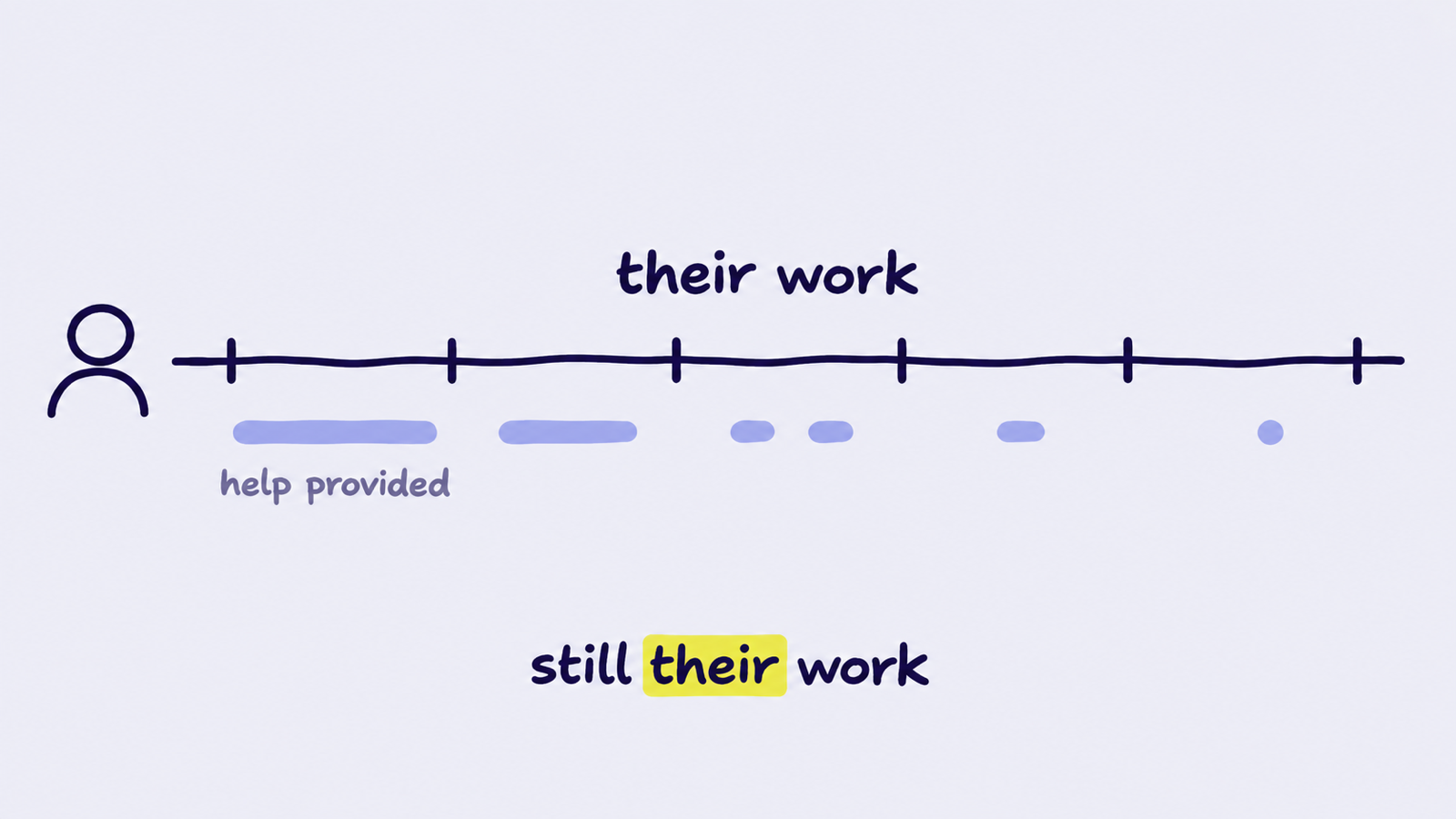
From Questions to Confidence
You can see whether the Enabling is working in what people bring you.
If it starts with a lot of questions, that’s fantastic, because questions show genuine interest. Somebody asking questions is figuring out the shape of new work. Let that run. Shutting questions down gets you a team that stops asking about anything new.
Those early questions matter more now than they used to, because the cost of starting has collapsed. Before, you might not even have known where to begin finding out about something. Now AI will give you a starting point on almost anything.
The flip side is that a starting point turns into output very easily when dealing with goal-seeking LLMs. If you’re just getting more output to review, the onus is back on you to resolve that bottleneck. Depending on individuals’ and teams’ levels of experience or agency, a lot of time can go into making sure they understand:
- the work, and the outcomes they should be looking to achieve
- the quality bar they need to hit
- any other guardrails needed, such as proper AI set-up to ensure no runaway bills
As gaps get filled and alignment increases, confidence grows. From there the job is to help shape, frame and edit those outcomes, coach people on them, and help with how they deliver their work to other people.
None of this is a ladder people climb. People come to it from different places. Someone with good judgement and high agency can make confident recommendations. Senior people may have experience but lack the core AI skills to understand what’s needed or involved. Their team, particularly Gen Z, may know the AI tools better but not have all the experience to understand any gotchas or the needed guardrails to protect the business while looking to grow. Everyone is at a different point on their journey, and each needs something different from the Coaching. AI can answer almost anything somebody asks it. It can’t tell what people should be asking, notice when they’re stuck, or hold them to the quality bar.
AI helps a person learn. A human enables the person to reach their potential. They’re two different jobs, they get confused constantly, and the second one isn’t going away any time soon.
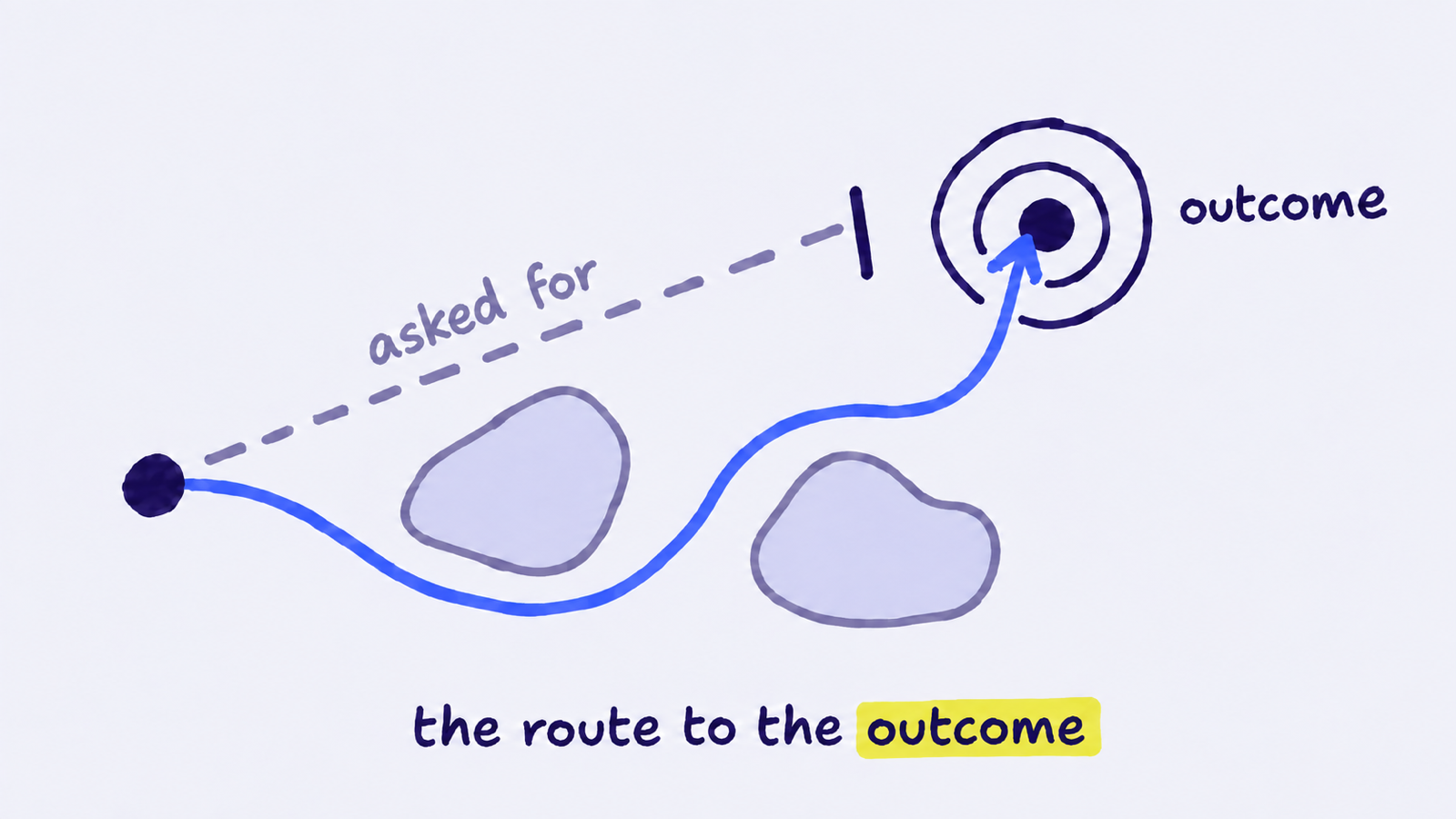
Where the Freed Time Goes
Using AI tools myself, I’ve found I can do less Doing work if I choose, and there’s more time for higher quality work. As people grow in confidence and their work consistently hits the quality bar, their time has to keep moving from output to outcomes.
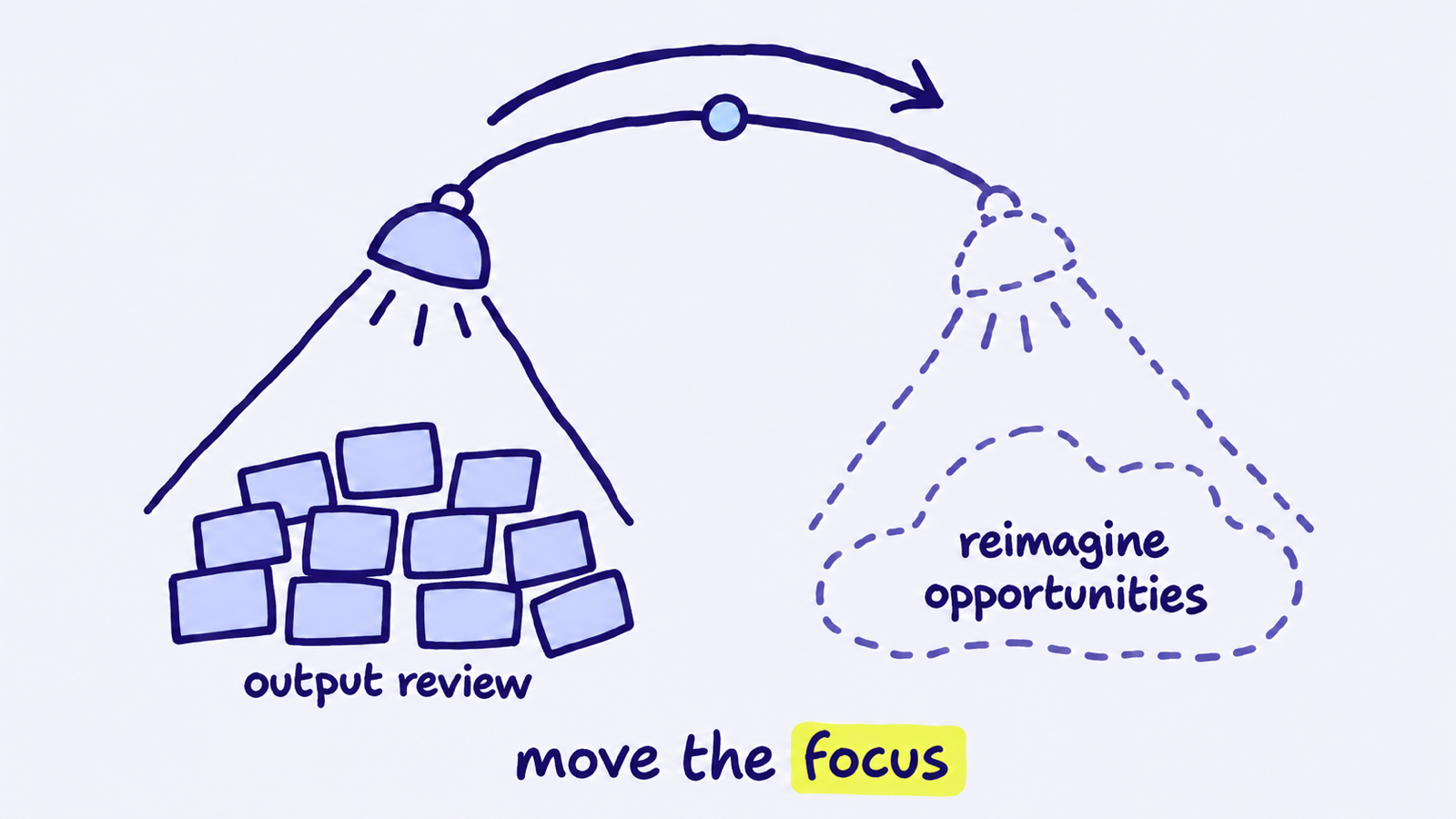
In the business scenario I mentioned earlier, my time got redirected to the next set of problems. There was as much Enabling as before, and probably as much Doing, just aimed at different outcomes. The aim is to put your time where it makes the biggest difference, and that keeps changing.
What compounds is the cadence of good outcomes. Once a person’s work consistently hits the quality bar, good outcomes come more often, and less of their time, and their coach’s, goes into review of the work. That time goes into quality or the next problem, where the same thing happens again. That builds momentum: moving faster, and doing things that were never possible before because nobody had the time, or the focus was wrong. Over time, this will lead to a different cost mix between people and technology that will continue to evolve.
Prove the Return Before Adding Cost
Cost cutting is done for a reason, but even when it works, it’s usually a short-term fix. Bain & Company, the consultancy, studied how companies came through the 2008 downturn, a financial crisis rather than anything to do with AI, and the ones that came out ahead reined in costs while also reinvesting in growth. Doing more with less, and nothing else, leaves you open to being beaten by your competition, compounding around you.
People and technology systems both cost money, so in larger companies, change shows up in what the markets wish to see in quarterly metrics.
If overall budgets are to increase, leaders need to know what the spend is returning, and on what mix of people and tech. Prove that return and there’s more to invest. Whether that goes on more people or more technology is a different question, and it doesn’t have one answer.
Sales shows what proving the return looks like, once everybody sells from a known playbook. When I was in sales leadership, a lot of the Enabling went into building that playbook: a shared way to qualify deals, with the same questions and the same sales process for everybody. Without it, one person’s read of a deal can’t be compared with another’s, and you get the timing and the probability of closing wrong. MEDDPICC is one example of that kind of qualification checklist. When we brought a new product offering to market, we tested the sales process with a few inside sales reps first, and refined it based on market feedback, before rolling it out to the larger team. Adding reps only came once the return on that extra cost was clear.
There’s a Human in the Loop, So Make the People Better
Coaching people and building a team aren’t things to automate, and trying to will cause problems. The way I see it, AI models are built to hit the goal they’re given, and they have little of the judgement about people this work needs. So there’ll be a human in the loop for a long time yet in many scenarios, to provide real-world guidance, reinforce the goals, and act as guardrails, keeping the risks in check while the business grows.
For me, a good company starts with the product, because a poor product makes a poor company and I’ve no interest in shilling something that isn’t worth selling. The same goes for people. If you need people, and you do, then hiring and enabling good people are what you work on to reinforce positive momentum.
So as time goes into building new systems, pipelines and workflows with AI, the same level of thought has to go into enabling the people who’ll run and work in them.
Making a specific team better won’t always make the business compound, because the bigger problems can sit somewhere else in an organisation. But if the team can’t get better, the business has no chance of compounding at all.
When AI makes the build work itself cheap, it’s easy to start seeing people as a cost, through the old ways of working. Making people better is a long-term investment. As a leader of people, what work is actually filling your week? Meetings? Administration? Busy work? The right priority things? How are you prioritising the growth and effectiveness of your team?
Leaders also need to look at their work mix. For example, running the same one-to-one conversation separately with ten people covers the same ground ten times. Bringing people who do similar work together, to work out better ways of doing feedback and update loops, cuts that repetition. People also learn better together, which builds a team instead of a set of individuals. Senior people can often get more from that group time. Earlier-career people still may need more one-to-one time, especially to learn the quality bar, but there are still better ways to provide this than scheduled one-to-ones, such as ad-hoc in the work for Editing and Coaching.
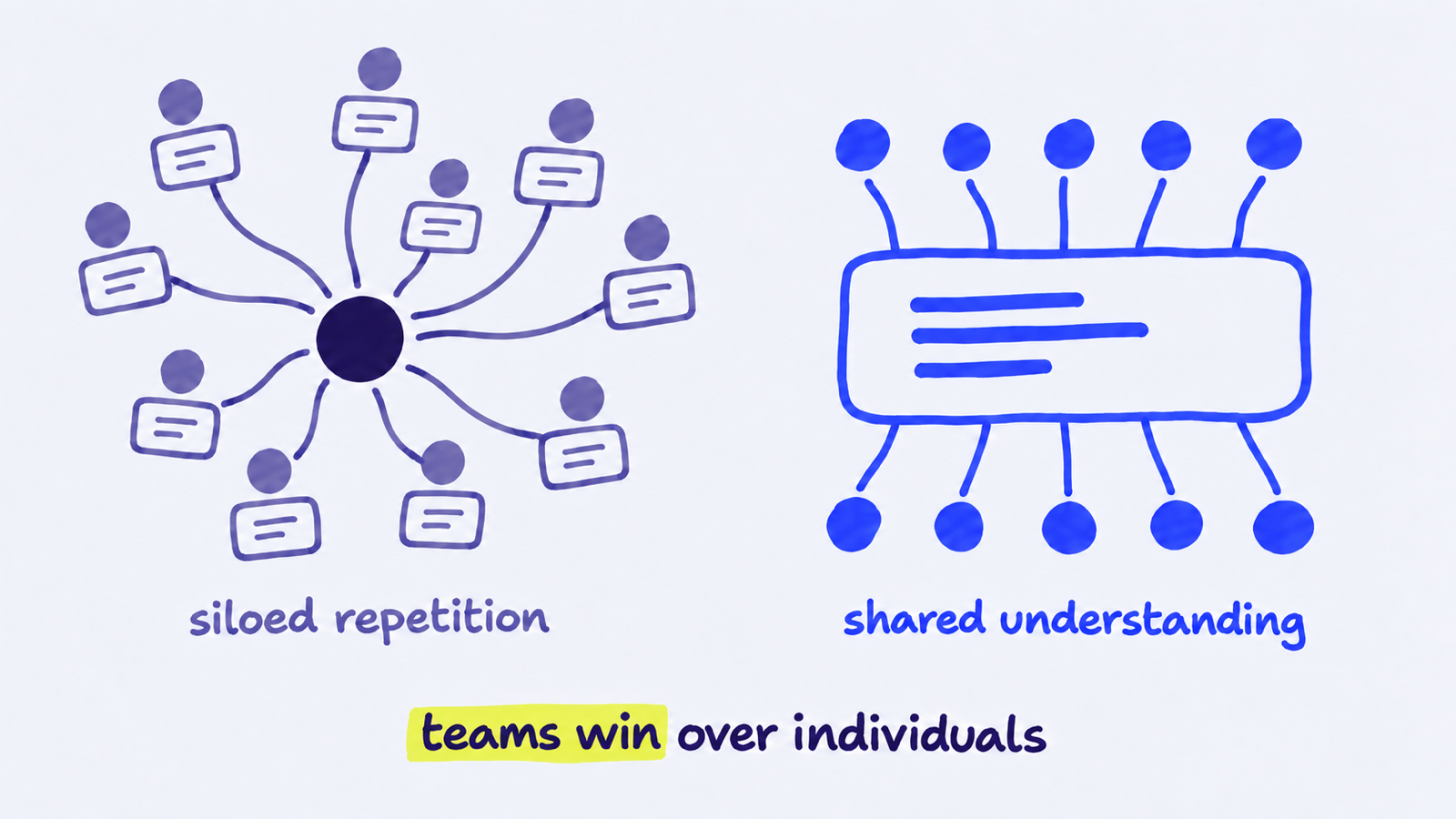
Uber is cutting nearly half its managers with one or two direct reports. Teams still matter, though, and teams certainly need to be bigger than this. As much as organisations look to make individuals more productive, there’s a need to reimagine the role of managers, and maybe even the title itself, so they become true enablers of company growth.
So, whose work got better because of you this week, and how would you know?
Sources
- Benedict Evans and Toni Cowan-Brown, AI deployment and the AI-enabled company, Another Podcast
https://another-podcast.simplecast.com/episodes/ai-deployment-exYtfRKI - Chip Cutter, Corporate America Is Axing the ‘Micro-Team’ Boss, The Wall Street Journal
https://www.wsj.com/business/corporate-america-is-axing-the-micro-team-boss-173d3e4e - A Conversation With Duke’s Mike Krzyzewski, Only A Game, WBUR
https://www.wbur.org/onlyagame/2014/05/24/mike-krzyzewski-coach-k-duke - Bain & Company, Winning in a Downturn
https://www.bain.com/about/media-center/press-releases/2019/winning-in-a-downturn/ - John Leenane, Improve the People, Not Just the Work
https://jalco.ai/writing/improve-people - John Leenane, Reimagine to Deploy
https://jalco.ai/writing/reimagine-to-deploy - John Leenane, Describe the Work, Not the Title
https://jalco.ai/writing/describing-work